
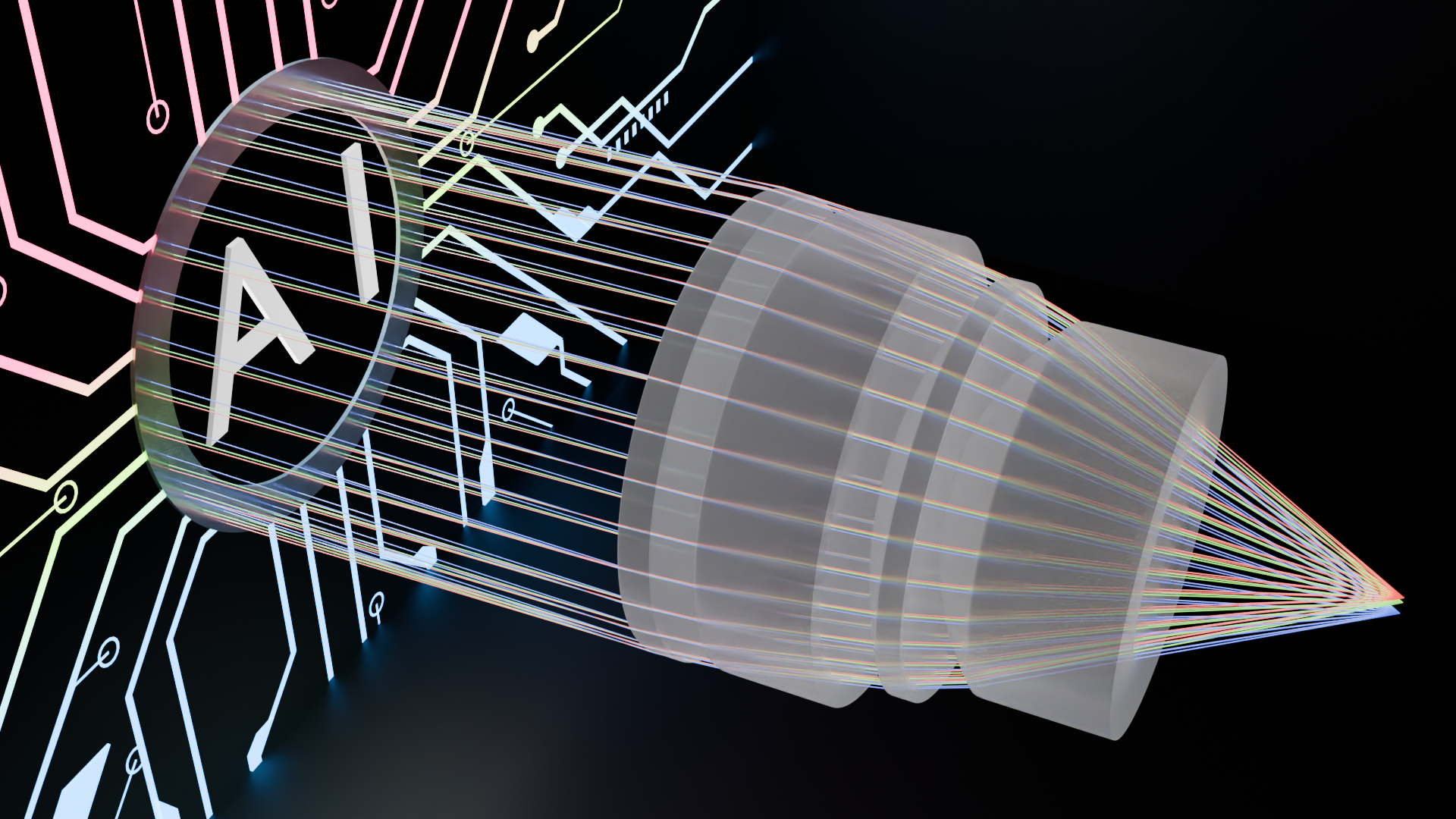
Paper: Artificial intelligence in optical lens design
Researchers: Ai Ping Yow, Damon Wong, Yueqian Zhang, Christoph Menke, Ralf Wolleschensky, Peter Török
Optical lenses are the fundamental components of advanced scientific instruments like microscopes, spectrometers, and laser systems. They are meticulously designed to focus or disperse light to form an image or modify its path.
But designing these optical lenses is painstaking work – requiring the intuition of expert designers combined with extensive trial and error.
Therefore, researchers have started integrating artificial intelligence (AI) into this domain, changing how optical lenses are conceived and optimised. This AI-powered revolution looks set to improve design efficiency, reduce errors, and enable innovative solutions far beyond traditional methods.
This blog will explore AI’s current applications, challenges, and future directions in optical lens design.
Understanding Optical Lens Design
Optical lens design involves selecting and optimising a set of optical surfaces to meet specific criteria. Conventionally, after specifying the desired focal length, numerical aperture, and field angle, lens designers manually define parameters such as surface shapes, glass refractive indices and thicknesses based on their experience and the specific requirements of the optical system. They aim to create a design that minimises optical aberrations while adhering to physical and manufacturing constraints.
A critical step in this process is selecting a starting point design (SPD). The SPD serves as the initial configuration for the lens, which the designer then refines. This step is often the most time-consuming and depends on the designer’s intuition, as the chosen SPD can significantly affect the final lens quality and suitability for the intended application.

The typical workflow for optical lens design begins with selecting a starting point design based on the given specifications, followed by initial evaluation and construction of a merit function for further design optimisation.
Evolution of AI in Optical Lens Design
Researchers first used AI in optical lens design to develop “expert systems”, which used rule-based programming to replicate the decision-making processes of human experts.
These expert systems can automate selecting SPDs, helping designers identify suitable configurations for different optical requirements. For instance, they can evaluate existing lens designs and recommend those most likely to meet new specifications, reducing the manual effort.
However, despite their early success, expert systems have limitations. They depend heavily on predefined rules and databases, which can become outdated as new technologies and materials are developed.
Moreover, expert systems cannot learn and adapt dynamically. Once the rules are set, changing or updating them to accommodate new insights or innovations requires significant effort.
As a result, the focus has shifted towards more flexible AI methods, such as machine learning, which offer greater adaptability and potential for innovation.
Machine Learning Approaches in Lens Design
Machine learning (ML) is a subset of AI that involves training algorithms on large datasets to identify patterns and make predictions. In optical lens design, ML techniques can predict the performance of different lens configurations and optimise design parameters.
ML approaches can be divided into three main categories: supervised learning, unsupervised learning, and reinforcement learning. In supervised learning, models are trained on labelled datasets, allowing them to predict the outcome of new data inputs based on previous patterns. On the other hand, unsupervised learning identifies hidden patterns in data without predefined labels, which can be helpful for clustering similar lens designs or discovering new design principles.
Reinforcement Learning: A Promising Technology
The third category of machine learning, reinforcement learning (RL), is an AI technique in which an agent learns to make decisions by interacting with an environment and receiving feedback through rewards or penalties. Unlike traditional data-driven methods, RL is dynamic, so it can handle complex tasks where the solution space is vast and not well-defined.
The potential for RL to select lens parameters without relying on pre-existing databases is huge. Instead of being trained on fixed datasets, an RL agent can explore different design configurations autonomously, learning how to achieve the desired optical properties.
As such, IDMxS researchers, in close collaboration with Carl Zeiss, are now pioneering RL’s aptitude for lens design, focusing on optimising parameters for specific tasks, such as reducing optical aberrations in basic lens systems. RL’s promise lies in its ability to discover novel designs that might not be evident through traditional methods or even other AI approaches. As this field evolves, we can expect to see more sophisticated RL models capable of tackling increasingly complex optical design challenges.
Supervised learning involves training a machine on labelled datasets to make intelligent predictions. Unsupervised learning surpasses manual data labelling and is trained by searching for similarities, differences, patterns, and structures within the unlabelled dataset using clustering or association. Reinforcement learning uses rewards and punishments as feedback mechanisms to learn task-specific behaviours.

Limitations and Challenges of AI in Optical Lens Design
While AI shows enormous potential in enhancing optical lens design, several challenges remain. One of the major issues is the high cost and effort involved in developing and maintaining AI systems, especially expert systems. These systems require careful programming and continuous updates to remain effective, which can be time-consuming and expensive.
Another significant challenge is the need for extensive datasets. Many AI approaches rely heavily on large, high-quality datasets to train their models. In optical design, creating or curating these datasets can be difficult, given the specialised nature of the field and the diversity of potential applications.
Furthermore, evaluating the performance of AI-generated designs is complex. Currently, there are no standardised benchmarks or publicly available datasets for comparing different AI approaches in lens design. This lack of standardisation makes assessing which methods are most effective and ensuring consistent quality across different studies is challenging.
Overcoming the Challenges: The Way Forward
To overcome these challenges, AI in optical lens design must focus on developing standardised benchmarks for evaluating performance. Publicly accessible datasets (like the IDMxS Mobile Phone Camera Lens Database) and universal evaluation metrics would help researchers compare AI models and identify the most promising approaches.
Another strategy involves integrating hybrid models that combine different AI techniques. For example, using deep learning AI models to propose initial lens designs, followed by reinforcement learning to optimise those designs further, could leverage the strengths of both methods. Such hybrid approaches could provide more robust and adaptable solutions to complex design problems.
Additionally, fostering collaborations between AI experts and optical designers is crucial. This multidisciplinary approach ensures that AI tools are developed with a deep understanding of optical design’s specific requirements and constraints, leading to more practical and effective solutions.
Conclusion
AI is transforming optical lens design, offering new tools and methods for generating, optimising, and evaluating lenses. From the early days of expert systems to advancements in reinforcement learning, AI has shown its potential to revolutionise this traditionally manual and experience-driven process.
However, challenges remain around data requirements, model transparency, and performance evaluation. Overcoming these hurdles will require continued collaboration and the development of standardised benchmarks. As AI technology advances, its role in optical lens design will likely expand, enabling more efficient, accurate, and innovative solutions.
The future of optical lens design lies at the intersection of human expertise and artificial intelligence, promising a new era of innovation and discovery in imaging technologies.
Read more: Artificial intelligence in optical lens design
Frequently Asked Questions (FAQs)
- What is the role of AI in optical lens design?
AI can automate parts of the lens design process, generate starting-point designs, and optimise configurations to meet specific performance criteria, enhancing efficiency and reducing human error. - How are expert systems used in lens design?
Expert systems use rule-based programming to replicate the decision-making processes of human lens designers, helping to identify suitable starting-point designs and automate parts of the design process. - What are the limitations of using AI in lens design?
AI in lens design faces challenges such as high development costs, the need for extensive datasets, and difficulties in evaluating AI-generated designs due to the lack of standardised benchmarks. - What is the potential of reinforcement learning in optical lens design?
Reinforcement learning offers a dynamic learning approach that does not rely on pre-existing databases. It allows for exploring novel design configurations and optimising lens parameters in complex optical systems. - What future trends can be expected in AI-driven lens design?
Future trends include the use of generative AI models, advancements in reinforcement learning, and the application of AI to more complex optical systems such as freeform lenses and multi-element zoom lenses.